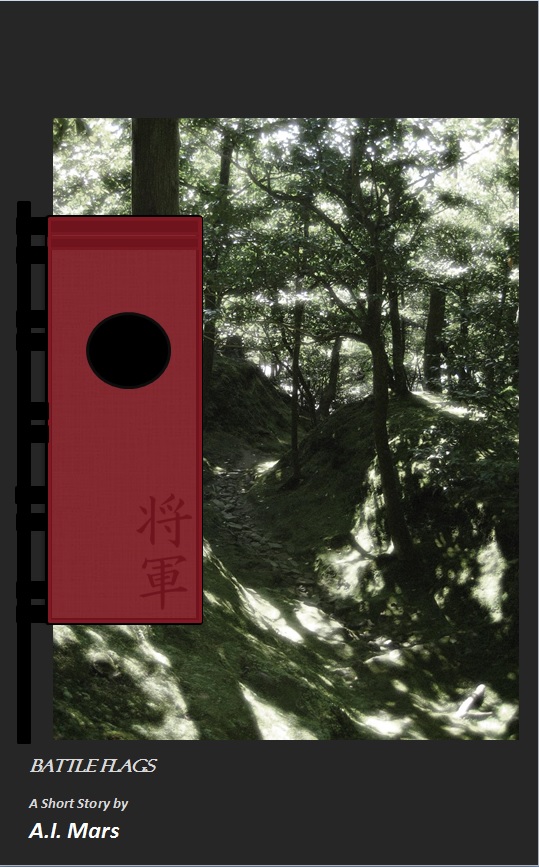
 |
©AIMars 2014
Battle Flags
Dramatis Personae
Hirayama Daimyo and Lord of the Hirayama Clan
Hachiru Chief Retainer, bodyguard, and counsel to Lord Hirayama
Shun Steward and bodyguard of Lord Hirayama
Eiji Steward and bodyguard of Hachiru
Tokugawa Daimyo of the Tokugawa Clan
Nobunaga Daimyo of the Nobunaga Clan
Shogun Ashikaga Military ruler of the unified empire, ruling authority in the name of the Emperor.
Lord Hando Emissary and field commander of Shogun Ashikaga; cousin of the Shogun.
Ieyasu Tokugawa Field commander for forward Tokugawa battalions; nephew of the deceased Lord Tokugawa, iconic patriarch of the clan.
Author’s Preface
This story is set in feudal Japan, during the Middle Ages, prior to the advent of gunpowder and firearms. The island of Japan was arranged in feudal properties, or estates, that were arranged in provinces, each with its own municipal government. As in the western world during the same time, the provinces were ruled by the vassals of noble and propertied families. Over the span of many centuries, Japan was unified, fractured, and unified again under a series of powerful feudal lords. Unification and relative peace were found in those ages, yet there was consistent threat of conflict and all-out war as rival clans sought to expand their properties, wealth, and influence. Position and affluence in this period was determined by hereditary lineage. However, it was also a time in which men who were not of noble birth were able to rise in esteem and rank, owing to their military abilities and accomplishments.
Under the Shogun, the vassals of the provinces were Daimyo; the ruling samurai leader, holding a position referred to as a knight in western military culture. The Daimyos were powerful governors, whose power was derived from the clan and family influence, military and political power and influence, and the overarching authority of the Shogun. As in all things, ambition and acquisition of wealth and power contributed to consistent instability and mobilization for centuries. For the average peasant farmer, life was the same regardless who was the ruler of the estates on which he lived. Peasant feared war, as they were conscripted as the foot soldiers in times of mobilization.
Battle Flags is historically accurate to the period, but not a depiction of history. It is merely a tale of events that are set in the fascinating and compelling time of the samurai and the military reality of feudal Japan. The names of principal players are provided for reference. It is a fictionalization of classic Japan, and the story is set in name and tone consistent with this era.
Battle Flags
Nobushige Hirayama sat on a carefully folded square of un-dyed cotton fabric. His attendant had studiously and meticulously folded the material as he was lost in meditation, staring into the trees. The morning was cool. Dew was on the grass beyond the edges of his makeshift dais, and he smiled approvingly to himself, finding that his steward had kept even the slightest drops from the barrier between civilization and nature.
In truth, Hirayama preferred to do even the most mundane, but ceremonial and martial customs himself. Lord Hirayama was not above polishing his gear or even chopping would should the need arise. He treated his stewards and vassals as men, and in private, he was always the master, but still a man amongst men. This day, however, called for ceremony to be adhered to, and it was just that his steward prepared his soldier’s pillow. He smiled again at this; whereas men his age and rank chose to spend their time, vitality, and life’s works on a seat similar to this, his was plain and utilitarian. His peers rode far deeper cushions, made of finer cloth – likely silk, and edging made of color and privilege. He sat comfortably in zazen, legs crossed, just as he did across the fire from his men, deep into the night on a long campaign. He understood the ceremony of sitting upright in seiza now, but decided that he would take his leave of this requirement and sit comfortably.
The Daimyo’s second, Hachiru, sat relaxed on a folding stool a few feet from his lord, his helmet on a folded cloth next to his feet. Considering the circumstances, he was quite relaxed. Perhaps it was watching his master sit with such poise and calm, floating above a field of soft distinct color from the short grass under the trees. He was a bit disappointed that Hirayama had not elected to sit upright in his waiting. But his own back seated above the stool was thankful for the rest, and he resigned that he bore his commander no grief for doing as he would have himself.
With the tension of this meeting in the glen, Hachiru considered again the instructions he had given to the stewards, his own, and that of Lord Hirayama. He had told the pair: they were to – if no other means of escape were possible – ensure that the lord was not captured, even if that meant to act as his second. They were not to allow the lord to be disgraced should he be set upon here in the glen.
Hachiru, Lord Hirayama’s senior retainer, was the oldest of eight, from a poor but respected martial family, knew the stewards were ready and loyal. Just as his lord, in quarters Hachiru allowed his men to call him by his name, without his rank. Behind his back his men teasingly called him Chou, a nickname they had come upon derived on his given name Hachiru, which means the 8th son. Chou meant butterfly, though they only jokingly said it when the lord’s chief retainer was far from the risk of earshot or reprimand. Hachiru was a hard, middle-aged man that laughed at a good joke told by the men, but was also the first to cuff a disrespectful peasant or junior troop, sharp enough on the ear draw blood. He was hard and fit. He still trained, but he knew he was fortunate. His back ached constantly from years on campaign, miles and miles spent in the saddle. But he had recovered from numerous wounds, illnesses, and even a broken heart in his youth. He knew the lord’s knees were bad; the lord was only three years older than Hachiru, but the he had spent as many years on campaign as any senior retainer. He forgave his senior his moment out of custom, and marveled as he saw the composed man, relaxed, his face tilted slightly up to catch the morning sun and feel its warmth on his cheeks.
“Hachiru!” The lord called out, not opening his eyes.
“Yes, lord.”
“So do you think this is our last day together, my friend?” Lord Hirayama kept his head held at an angle, taking in the sun as if he were simply in a moment’s rest in the shade of the trees, not marking the time until the arrival of judgment. Hachiru smiled. He was always the pessimist in dire circumstances; he knew the lord was baiting him.
“I don’t know, sir.” He called back. Hachiru then called out- “Shun!”
“Yes, sir?” Shun was seated upright on his knees to the lord’s right. He was 35-years-old. He was 12 years younger than his lord, and nine years younger than the guard captain. He had been with Lord Hirayama since he was 13.
Shun too, was a son of a home with a fine martial name but no family fortune. His father had brought him to the lord’s manor his last day before his 14th year. At that time, it was Lord Hirayama’s father, Lord Suya who had been regent of the lands and heritance his lord now held. Hirayama had been present when Shun’s father had respectfully asked for the honor to place his son in the service of the lord.
Shun had been scrawny then, and had felt shame in his cheeks as he was offered as servitude to the lord of their region. It was only years later that he realized his good fortune and the good, meaningful life he held. He ate well. He kept his family and child on the grounds of the great house. The lord treated his child as his own, and he was sure that if their band of four men in the glen lived through this day, that his son would find sponsorship, likely even adoption, by the lord prior to his passing.
Hirayama had been present as the eldest son that day, in the lord’s room for receiving guests and giving counsel to local grievances. He had returned from six months inspecting his father’s lands and making the necessary rounds of political and feudal cordialities to maintain relations within the regency governed by his father. His steward had died of fever in the spring on their return leg home, and he decided in that moment to request Shun for his personal valet. Lord Suya had granted the request, and Shun had been Lord Hirayama’s personal attendant since that moment. He was not a servant. He trained with the lord and the senior retainers. He had drawn blood on many of the best swordsmen in the lord’s guard. He was a steward, but he was also a soldier. He took pride in his attention to detail. Much as keeping the sticky droplets from marring the folded edge of the seat he had made for the lord. Shun felt the handle of his long sword prominent across his hip as he was seated, his eyes closed in the sunlight, hands clasped in his bent lap.
“I don’t know, commander.” Shun squinted one eye at the hazy sun still low in the sky. He called out- “Eiji!”
“Yes, sir.” Eiji was seated to the right of Hachiru; to the left of the lord. He was Hachiru’s attendant, bodyguard, and confidant. Shun asked him- “So what say you, Eiji? Is today our last time in the morning sun?”
Eiji was one of male twins; he too was of simple origins. Lord Hirayama had greater faith in men of shown value and grit than those of noble lineage. There was often friction when Hirayama’s armies coordinated with other feudal forces in the region. All of Hirayama’s top retainers and leadership were simple men; given respect, wage, and land bought of their work and loyalty. Whereas retainers could often have their allegiance bought, not a man in the Lord Hirayama’s service would seek to live a day past tomorrow should this outing prove to be their demise.
Eiji was the youngest in the party, lank and muscular. He was an excellent archer, and shot high in the saddle. He was 32-years-old, and this was not the first instance in his time of service to the daimyo he had given pause to wonder if he would return home to camp that evening. This was the worst though. All times before this morning, the outcomes were many in possibility, although victory or defeat were the only terms recorded after the fact. This was more tense, made worse from the formality of it. He was impressed yet irritated with his lord’s composure, as he felt the urge to stand and pace. Perhaps to chop a tree or two. Not with his primary blade; not even the shorter blade that was bound under his haramake. Eiji was charged with firewood most times when they stopped, so he carried an old blade in addition to his wood axe in his pack. Eiji was fast and agile; he made good use of his duties at firewood, turning a task into training. He too, closed his eyes and pointed his face at the sun. He hesitated a moment.
“I don’t know, sir.” Eiji paused a moment with his eyes closed. “I should hope not. Shun was careless in preparing the lord’s throne. I noticed a drop of water, perhaps even a few, showing at the edges of his handiwork. It would be quite a disgrace should the lord meet his end in such squalor.” The lord laughed out loud, and almost brought his head down from facing the soft touch of the sun against his face.
“My, my, Shun. I hadn’t noticed you have set me out for presentation, yet even the lowly drops of dew seek to defame me in what may be my last hour.” Words such as these – either those in insult from Eiji, or those in apparent rebuke to his steward from the lord – would have caused other men to wilt. But these men were comrades. The lord was just that – the lord. But they were all men, and as well as the stewards and retainers had given their lives in service to Lord Hirayama, so too, had the lord given his life in service to them.
Shun almost opened his eyes, but merely said-
“Forgive me, lord. I beg your pardon. Should we be presented with similar circumstances in the future, I will redouble my efforts and be diligent in the preparation of what may prove to be the last seat you take. So that you may depart this earth, confident that your ceremonial accoutrement are accordingly representative of the esteem you deserve. A thousand pardons, sir.” The lord laughed again.
The composed master smiled and brought his face down from the sun. He laughed. He looked down at his hands in his lap. They were worn, a calloused crease in the crook of his palm and smallest finger, worn tough and leathery by days holding the reins of a traveling horse, over years of miles riding to the corners of his small fiefdom. He was pleased with the callouses and that his hands still appeared as those of a soldier, not an administrator.
“Ah! That I suffer such indignities in what are perhaps my final moments! I sincerely hope that you will be presented again with the opportunity, Shun, to amend your duties and ensure that I am adequately arranged should I find myself in similar circumstances. In any event, I forgive you your inattentiveness.” Hirayama made his retort to his steward.
“However, should we meet in heaven, you will still owe me the debt of a properly arranged cushion.” He laughed. The other three men laughed with him. Not patronizingly, but as comrades. The hardened soldiers heckled each other the same as boys did. Humor and bravado were the best methods to have in hand when meeting what may prove to be a sentence of execution. The sun was now reaching above the trees of the glen, the light creating moving waves of shade, like waves rolling along the edges of the grass in the small field. The insects in the grass began to carry on with their daily song, ignorant to the tension and awaiting storm that had come to visit the glen early this morning.
“Lord!” Eiji called to the master.
“Yes, I hear them.” More distinctly the sounds of horses pounding up the trail leading to the glen came to the waiting band of men. There was an occasional jangle and sharp noise added in with the dull thudding of the animals. Equipment improperly secured for travel, leaving metal and stiff parts to sound as they clattered against each other when underway. The man-made sounds indicated these were not combat soldiers or those with any field acumen. Hirayama was sure that when they came into view, their armor would be pristine and beautiful, with not a scratch on it that was accumulated outside the walls of a castle somewhere.
The pounding and jangling was now close. Lord Hirayama breathed deeply, and returned his face to the sun, closing his eyes.
“Red, sir. The standards are red.” The battle and heraldry flags of the envoy could barely be seen above the bushes and through the trees as they approached. The horses pounded closer. Red? They had expected white. Or black; those of the Lord Nobunaga.
Red? Hirayama refused to open his eyes, remaining placid. He decided that to consider the color of the streamers on the approaching riders was meaningless. Instead, he thought of his pavilion in the rear of his home.
He had worked for years, with his own hands, to fashion and shape his garden to the image that existed in his mind. After more than a decade of work, he was pleased with his result. The scene matched the tranquil and ordered reality he had maintained in his imagination since childhood. He thought of Shun’s son. A fine young man. The lord had no children of his own. He had been married twice. Once to his true love, and then in a marriage – though not unpleasant – that had been made of political convenience and allegiance, not sentiment. Both his wives had died; his sweetheart in childbirth of what would prove to be his stillborn son, and his friend and political partner that was his second wife had died of fever ten years previous. They had shared marital relations, and enjoyed each other’s company. His second wife had been alive when he had begun his garden. She watched quietly and respectfully. Her quiet support and appreciation of his handiwork was almost as satisfying to him as the heady swoon of love had been with his first.
Red. What exactly did that mean?
The horses pounded loudly as they made the glen. The men atop the horses were of noble lineage, but had never seen battle. But their understanding of courtesy and respect had them bring their horses up short, just beyond the trees and foliage surrounding the glen. Hirayama and his men heard the jangle of metal and armor as two men dismounted. There were six of them. The dismounted soldiers held the reins of all six horses, three to each. Hirayama remained passive, his eyes closed, his skin soaking in the warmth. He hears two more riders dismount, the sounds much the same as the first two. A moment, then the last two riders left their mounts. More jangling. A loud cough. Then footsteps as two of the troop came into the glen. The four foot soldiers remained with the horses, all dressed in ceremonial armor, the only deficiency was road dust that had accumulated on their ride to this spot.
“Hunh.” Hachiru grunted in disgust. He hated toy soldiers. Effete snobs that preened and pontificated yet had never been on the receiving end of a falling rain of arrows. Or weeks on rice and gruel, as the lord refused to ransack farmlands or merchants while on campaign. Not the villages of his own properties, but also not in any of the towns or farms of neighboring lands, the residents simply unfortunate enough to be on the wrong side of a property line or feudal barrier.
“Pftt.” Hachiru spit into the grass next to his stool. Eiji almost laughed out loud. He would die for a man that spit at the sight of a pompous administrator dressed in the gear of a warrior; such worthless men tasked with bringing a sentence of life or death for their lord.
Shun, posted on the other side of the lord tried to hear his master’s breathing. Saw his face still tilted at the sun. He felt pride. Pride in his master; pride in himself. His lord showed such great composure. He had still shared one last moment of camaraderie with his men.
The men striding into the glen, Shun watched them as they tromped like peasants over the damp grass, carrying the word which when revealed in just moments, would bring consequence of life or death. For the lord, and as such, for the three others who sat in the glen waiting with him.
The second emissary, younger and taller, had a battle flag affixed to the rear of his armor, same as the attendants that remained with the horses. The shorter, older man carried no streamer. Shun noted the color and design of the flag. Red. All red, with a black orb in the center. The eye of the dragon. The Shogun’s emissary. Red. Not white of the Tokugawa clan. Nor the black of the Nobunaga house. Red, the Shogun’s standard.
They had been awaiting emissary from Daimyo Tokugawa or Daimyo Nobunaga. Had the streamers been white, that meant that Tokugawa had defeated the Nobunaga armies. When one of the major daimyos of the shogunate –there were scores of them- had made designs on expansion and to subsume the lands, titles and holding of the other, Hirayama had been caught in an impossible dilemma. Trouble had been brewing with the Tokugawa clan since before his father’s patriarchy. The house of Daimyo Nobunaga had always been considered friend and ally to Daimyo Hirayama.
Hirayama’s estates bordered both the Nobunaga and Tokugawa provinces. He knew that if he was drawn into a conflict outside his borders, his entire province could be sucked into a war that was not his to win nor fight. Conversely, his armies could not withstand a direct campaign into the Hirayama properties of the forces of Tokugawa, and counted that this was not a concern with Nobunaga. In this, nor could his lands be could not be taken by Tokugawa without a heavy price. Resistance by a fiercely loyal populace, soldiers that would fight to the death, taking with them to death every single enemy of any flag or lord aligned against Lord Hirayama. This, and the fortuitous fact that his hold was a small feudal province that existed removed from the collected lands of the shogunate. But it had strategic value owing to its position, and how geography had dictated war and fortune for the history of his martial world.
The taller man stopped at a respectful distance from the lord. He fell to one knee and bowed, his red sashimono fluttering for moment. His senior carried on the last few feet and kneeled before the lord. Hirayama noted the crown of the man’s helmet. There was dust collected on the brim but the top of his helmet was gleaming and clean. Shined and polished. Not a soldier’s helmet. A trooper’s helmet would be worn and scratched on the top, either from sitting on its crown on the ground, being used as a footrest, or even a pillow. The lord sighed to himself.
“Lord Hirayama.” The envoy bowed deeply. He was younger than the lord and Hachiru, but older than the stewards. He kept his head inclined to the ground, waiting for recognition by the lord.
“Speak, envoy. Tell your steward to relax, and have a seat for yourself.” The emissary settled somewhat, and raised his head. “Thank you, Lord, but I prefer to remain at attention. I must declare the Shogun’s message to you and we must return immediately to camp. It will take us days to return.” Daimyo Hirayama sat placidly and nodded to the messenger to proceed. The courier began reciting the edict of the Shogun. It was a verbal message, which was unusual.
“Daimyo Hiryama- his lordship, Commander of the Armies of the Son of Heaven, patriarch of the Ashikaga clan, and mortal descendant of Hachiman, Shogun Ashikaga does request your assistance…” Hirayama almost opened his eyes.
The situation was complicated. As he listened, Hirayama tried to simplify the situation to its basic elements. He began to assemble these pieces, to put them in a form a line trooper would make sense of, to die for or one of his commanders. He tried to make sense of events the situation. How to make sense of it, frame it, for those who couldn’t grasp the politics and stakes involved.
The daimyo sighed to himself. The story was incredible. Had he not been certain that it truly was the Shogun’s envoy recounting the tale, it would have sounded too absurd to be true. Some of the explanation and report given by the envoy, Hirayama already knew, but there had been unbelievable developments that had yet to reach his house.
The patriarch of the Tokugawa clan had died the previous summer. By fall, the senior son and the former lord’s brother had embarked on what they had planned for years. They had merely been awaiting the master’s death in respect and to greater prepare for war. The Tokugawa clan had boiled in bitterness, feeling it had been cheated in the boundaries created after the wars of unification by the previous shogun more than three generations past. The target of their ire was the Nobunaga clan, as the lost estates were given to that house after the resolution of war debts in unification. The Tokugawas had remained in good graces with the shogun owing to Lord Tokugawa. He was bellicose and arrogant, but shrewd and careful to make allegiances and curry favor where it was best. The senior Tokugawa retainers all carried their lord’s conviction- loyalty to the shogun, as dictated by necessity, but the aims and redemption of Tokugawa lands and name were the creed of the Tokugawa clan as soon as they returned from the capital and crossed from the western provinces into their estates.
With the passing of the patriarch, both Nobunaga and Hirayama knew what was to come. And as expected, Hirayama received request of allegiance from both the house of Nobunaga and Tokugawa. He had prepared for this likelihood, and respectfully declined to them both, sending a personal envoy with his seal and message to each.
A few weeks later, in the last of the winter of this year, Lord Nobunaga had sent a personal note in return with Hirayama’s emissary. In it, he remarked that he understood Hirayama’s position, and that he would have given the same answer had the circumstances been reversed. There was no reply from Tokugawa.
Almost six weeks later, farmers with a cart and oxen appeared at the gate to the Hirayama manor. In the cart were the boxed remains of the envoy. Two rough-hewn wooden boxes. One for the corpse in his armor. The other, a box not suitable to carry chickens, carried the head of the emissary, still strapped in his helmet, the crown buffed from service. It had taken three days of meditation for Hirayama to calm his soul from the absurdly disrespectful rebuke from Tokugawa. He would not be baited nor engage beyond his previous promise to the two commanders. But he knew what lie ahead; clear, distinct paths that were a world apart.
Should Nobunaga prove victorious in repelling the Tokugawa incursion, things would carry on much the same in the Hirayama hold. Conversely, should the Tokugawa armies defeat Nobunaga, then it was clear- it may take time, but Hirayama’s rejection of allegiance would be avenged after Nobunaga had been dispatched. With both the provinces at his borders aligned against him, Hirayama would not be able to defend his estates.
As the war began that summer, everyone in the Hirayama clan gave their requests and prayers to the spirits in hopes that Nobunaga would prove victorious. By fall it was still unclear how the overall war would result. Tokugawa had successfully made incursion deep into Nobunaga’s lands. The last reliable report that Hirayama had received showed Tokugawa close to the Nobunaga capitol manor. And thus, to the ten men meeting in the glen. The command from the provincial regency, presumably in the hands of the Tokugawas, had come to mandatory audience here in the glen; this time, this day. They presumed to make camp here and receive the results of the Tokugawa campaign, and respond to the inevitable draconian demands of the Tokugawas.
Hachiru and all the senior retainers feared an invitation to assassination, but Hirayama refuted their assumption. He knew the Tokugawa hatred for his neutrality – and as such they viewed it as siding with Nobunaga – would be rewarded with some demand with which he could not comply in good countenance. As such, he would be forced into a political, filial, and martial decision. Tokugawa would not let him escape that house’s wrath with simple assassination. No, it would be something insulting and personal. Something his men would bridle furiously at, and in the end Hirayama would have to reject the demand, even with the house of Hirayama at stake. Ironic, now that all this was moot, as the man speaking was wearing black and red, speaking for the Shogun.
“The forward armies of the Tokugawa were successful in their assault of the Nobunaga manor.” Hirayama returned to the report, noting the incredible tale unfolding.
The estate taken in the assault was not the castle of the Daimyo Nobunaga, but a large family manor in a remote section of their province. Nobunaga had retreated there, after deflecting a major assault. He had fought his way out of a skirmish, and saw the opportunity to hold and call reserves. He waited on the arrival of his reserves to flank the frontal assault, but he tarried too long and the command retinue was attacked vigorously. Lord Nobunaga escaped, but he and his retinue were separated from the battalions. He had sent for reinforcements and counted on their expedient arrival. He had not counted on Tokugawa scouts pursuing their caravan and troop signs to the Nobunaga country manor. A large residence which was designed to be well-defended, although it was not an edifice built for prolonged battle.
A company of Tokugawa foot soldiers, pushed hard by light cavalry had come pelting out of the woodline close to the manor. Guards had seen the rush of infantry from the towering third floor of the house. They were not even established on the grounds yet, having arrived shortly before the panting horde caught up to them. In sounding the alarm, the perimeter guards were able to pull all the peasants and stewards present on the grounds behind the wall and into the main house. There were stone defenses and gates, but in short order the battalion of foot soldiers had forced the entire Nobunaga command staff to retreat into the building. Some of the 40 soldiers of the command element died, protecting their master as he withdrew to the main house. The house was full of the groundskeepers, maids, and all the children and immediate family of those who resided in the servant’s quarters on the manor.
The children were frantic and were crying. They had been playing near the house, knowing that there was battle somewhere nearby, but that they were safe at the lord’s house. Their youthful reality of life in the country had been interrupted by the pounding of horses, hours before. Seven men had driven into the courtyard by stables. They were clad in black, and the cavalrymen wore a red standard with a black orb in the center. The senior groom of the manor, an elderly man- a retired warrior himself, almost expired at the site of the cohort that had arrived at the property.
The house captain came to the yard immediately, and the boy grooms took the horses to water and rub them down. The Nobunaga host profusely apologizing for the state of the manor, despite the immaculate appearance of the estate. They had no idea that someone from the capitol, much less the office of the shogun, would come to their rural retreat. The house captain escorted the entire party inside, with the envoy captain in the lead, worn but clean and polished dark armor, his rank omitting the wearing of the ceremonial sashimono.
The visiting emissary posted his guards at the door and entered with his steward and senior retainer. The entire manor was in utter disarray, as all the house personnel raced to polish and clean areas out of sight from the visiting party. They had not expected visitors, save perhaps the lord or a senior member of his family or retainers. The staff kept the manor and its grounds immaculate as the natural state of order, but they were shocked by this visit. An unannounced visit by the envoy of the supreme commander of the feudal regions, the Shogun, who served as the commanding representative of the Emperor.
The children were confused and stirred up, but dutifully went to sweeping and tending chores in the house. They didn’t understand the need to re-do the same chores they had performed already that morning. The house captain and matron arranged the guests in the lord’s sitting room. They brought fresh water and warm towels. The house captain, who also tended the lord’s gardens, was quite proud of his lord’s handiwork and his own attentions that retained the serendipity of the lord’s personal space. He pulled the shoji open onto the gardens, to display its beauty and perfection to the honored guests.
The house captain was questioned as to the location of the Lord Nobunaga. Where was his command element, or where was the retinue in the battle line? The envoy and escort had been sent directly by order of the Shogun to deliver a communique to Lord Nobunaga.
The house captain and the senior groom, both old warriors, had known that there was a major battle assembling not too far off. In recent weeks, the lord’s couriers had made mention of his military movements, to the brewing attack from the enemy clan, but the couriers refused to be specific, for the lord’s safety. The standing order was: there was no trouble anticipated, but remain ready should friendly soldiers retreating or in need of quartering overnight arrive at the manor. After entertaining the shogun’s envoy, a cousin to the Shogun himself, the house captain went about explaining that perhaps the lord’s unit was nearby, and runners had been dispatched to announce the arrival of the royal representatives and hope to return with Lord Nobunaga or one of his senior retainers.
Lord Hando, the Shogun’s cousin and a campaign veteran himself, thanked the elderly housekeepers for their hospitality, and asked for a quiet room and mat to rest and hope for word from the messengers. He ordered his steward to attend to his pack and told his guard retainer that he was off to rest and meditate. He advised his second to let the men do the same at his discretion.
The manor, residents, and guests had almost achieved a state of calm after the initial flurry of surprise and activity, when the drumbeat of horses came over the hills through the lord’s orchard. Had the ensuing tragedy not transpired, the marvels of this day would have been forever remembered by the all the farmers and Nobunaga clan in the region- an envoy of the Shogun, and their master Lord Nobunaga, on the same day.
The house staff, with the exception of the veterans, was removed from the gossip and oral information pathways of the municipalities, to information of any martial nature. The staff had been given instructions by the lord, sent by messenger, to make preparations and plans in accordance to war. This was the lord’s personal retreat, and favorite recompense for his senior staff, their families, and the lord’s own relatives. It held nothing of value save its beautiful tranquil location and the stores and provisions for vacationing or summering guests. It was not a major hold of the lord’s properties, and many outside the boundary of the Nobunaga estates didn’t even know it existed.
The lord himself was tall in the saddle in the midst of the pack of soldiers astride horses that pounded into the stable yard. The small platoon dismounted and pelted into the courtyard and ordered everyone into the house. Lord Nobunaga strode firmly from the stable into the house, his senior retainer accompanying him, and various juniors shouting instructions to the soldiers and the now-frightened staff. They scurried inside, now afraid, as hard, sweaty men clad in armor were shouting and running to the walls around the tall house. The house was enormous, and fit the estate staff of 20 and their families.
“Trooper.” Hirayama interrupted the shogun’s messenger. “Yes, lord?”
“Let’s pause. Drink some water. Actually, I think Shun or Eiji should have a vessel of wine in our packs.” The lord ordered Shun and Eiji to fetch water and the wine, and to return with field stools for the lord and the emissary.
“Hachiru- please come sit with us. I would like your full attention and to hear it as I do.” Hachiru brought his stool and drew it nearer to the lord’s makeshift dais. The lord himself stood and shook his cloth cushion, walked to the short pine trees and hung the fabric neatly. He returned and sat on the folding stool Shun had collected from their packs.
Lord Hirayama thought rapidly as the story unfolded. He imagined piecing together those critical notes and creating a dispatch for his maneuver commanders, explaining the situation in barest terms.
The Tokugawa army was successful in defeating the Nobunaga clan, killing Daimyo Nobunaga himself and his senior retainers. The lord had been trapped and laid siege to at one of his country manors by forces of Tokugawa. Withdrawn into the house, with the entire manor staff and children barricaded inside, the troops surrounding the house had demanded the immediate surrender of Lord Nobunaga and all his retinue.
The Tokugawa battalion commander, Ieyasu, a nephew of the deceased Lord Tokugawa himself, was a young man, given a field commission far beyond his maturity or ability. His scouts had tracked Lord Nobunaga when Nobunaga had broken contact with the main battle line, and had been attempting to retreat or regroup. He has flogged his soldiers like slaves from atop his horse, forcing them at running speed for miles until they had come into sight of the manor in the distance. He had sent the foot soldiers into the woods surrounding the manor. The rural and expansive grounds gave ample time for them to be seen as they assaulted, but no matter. He cared not, for he knew he had them trapped, pressed against the lake, with the mountain standing quietly over it in the background, a scene of tranquility to be seen from one of the sitting decks at the main house.
The initial attack had been essentially uneventful. Ieyasu’s men were utterly exhausted from the forced march, and in seeing the approaching fatigued horde, the Nobunaga forces had withdrawn to the main house.
The central house was a sturdy three-story square, with additional garden viewing and sitting rooms attached to the sides. The small stone walls were more ornamental than functional, and the large wooden house, built some 100 hundred years before, was a closed fortress on the first floor, now shuttered and barricaded, the sound of frightened humanity emanating from the verandas and rooms upstairs. Upon the third story was built a cupola on the top. Not a fourth floor, but an archer’s tower, as well as housing the ceremonial bell of the manor.
Nobunaga’s archers had shot a number of Tokugawa soldiers that were careless enough to be out from cover. When Ieyasu Tokugawa, the nephew of the lionized patriarch of the clan, witnessed this, he was enraged to see his soldiers pierced by arrows slung from the tower. He kept yelling at his men back to assault the house to the front, and back from the gardens and waterway leading to the lake beyond the grounds. His men had again tried to get close to the house, but two had been shot by archers from the tower while trying to make their way across the ceremonial garden. The bowmen, yelling down insults at the Tokugawa soldiers as they lay dying, for having defiled the master’s private garden.
Another trio of soldiers had made it sprinting to the foot of the building, blocked from the archer’s line of fire by the overhang of the verandas to the building. They hovered near a corner of the house, afraid to directly approach the barricaded outer veranda doors, and dearth to expose themselves to the deadly arrows from above. They cowered, huddled together, their line commander screaming at them across the field in a rage to move forward onto the porch.
They were just farmer’s sons. Two were less than 20, and the elder at 22 was the only one that had any training beyond what they had been forced to endure when the Tokugawa clan made plans for war and began conscription in their province. They all whispered violently and tried to gain their collective nerve.
As they almost reached the hysteria to move or attack, a shuttered window on the second floor above them slid open and an enormous pot of boiling water was dumped directly onto them. The men screamed in agony and attempted to flee. One fell before he made it through the raked sand of the garden, and died of shock where he lay. The other two made it away from the house, with their immediate commander all the more furious and enraged, screaming at the men as they retreated, flogging them with a short field baton. The second man died four days later of shock and dehydration from the horrific burns he suffered. The last man, though least injured, would carry the scars of waiting too long under the eaves for the rest of his life. He deserted in the middle of the night three days after the battle, disappearing into the woods and returning home to his village in a corner of the Tokugawa province.
The retreat of his men made Ieyasu more incensed, as he had been shamed by his enemy, his men refusing to advance, and then running in retreat when the old man and a soldier had dumped the boiling pot on his troops. He again demanded the immediate surrender of Nobunaga. His men completed surrounding the enormous building and grounds; they stood in position and awaited further orders from their line commanders. They awaited the general order from Lord Ieyasu. One of the line commanders approached and informed the lord of the seven horses in the barns, bearing the standards of the shogun.
This complicated matters immediately. In his young, angry and ambitious mind, he felt that the presence of the shogun’s envoy in the house was an affront to the Tokugawa clan. That by being in the house with Lord Nobunaga’s clan, the emissaries, and thus the shogun, had taken sides in the war.
The Tokugawa hierarchy had been certain and received word – paid for, of course – that the shogun would not interfere if the Tokugawa’s were to seek forcing a redrawing of provincial and proprietary boundaries. That the shogun’s men were in the house, even as he demanded surrender, fueled his anger to vitriol.
Ieyasu demanded the shogun’s men come out of the house. He promised immunity for the shogun’s men; they would be permitted to consult with his own commander when he arrived. The shouted reply was that the envoy refused to come out. The strong voice inside the house demanded that Ieyasu withdraw from the house; that he had threatened an emissary of the shogun, a capital offense, who was also a family member of the shogun. The defiant voice also added that he felt the company of old men, women and children, at the side of soldiers, was far better than sharing tea with the pompous arrogant ass screaming from just beyond arrow range.
This became too much for Ieyasu. He could not brook the insult. Not in front of his men, not in support of the Nobunaga savages that were hiding in the house with the women. He yelled for his archery platoon leader, and gave them order to encircle the house. They were to take a foot soldier with them, and to knock arrows swaddled on the tips with pine tar and cloth; fire arrows.
He again bellowed at the house for the shogun’s emissary to come out, and for Nobunaga to surrender. He threatened to burn the house to the ground if they did not comply with his demands immediately. In his naïve, young and arrogant mind, he was sure that with the threat of fire, every man’s primal fear, all parties trapped in the house would surrender. He was sure of Nobunaga’s misguided loyalty to his servants and retinue would force him to surrender, rather than have his entire house burned alive.
No answer came from the building. Ieyasu paced, fuming and enraged. He called for the archery platoon commander. He ordered for an archer to fire a single burning arrow into the wood below the cupola. Ieyasu would give the command.
It was to be a warning shot, stabbed into the wood, high on the building where one of the Nobunaga archers could dislodge it before it caught fire to the wood. They would see that there was no escape. They would feel the fear; that the building would be burned to the ground, with all the people trapped now, set alight by the arrows of almost forty archers assembled outside in the now failing light.
As often happens to armies across centuries and continents, the order given to the archery commander was then sent on foot by junior squad commanders to the line archers themselves. In this process, by the time the message reached the archers on the far side of the house from the Tokugawa command element, the orders were understood to mean: at the command to fire, all archers fire one flaming round into the house.
Ieyasu waited for minutes, counting away impatiently until he was sure the fire orders had been given to the entire archery platoon around the house. Ieyasu’s orders were clear in his mind- one archer was to fire one arrow into the cupola; all archers were to be in position, and await his further orders to fire.
He gave the command himself, bellowing loudly. A single archer nearest to his group of senior retainers fired a long, arcing shot that lodged just below the large bulwarks of wood that held up the cupola. He smiled in satisfaction as the burning arrow drew a loud yell from the high tower and a bucket of water was dumped onto the arrow extinguishing it.
Ieyasu was then amazed, and couldn’t understand what he was seeing transpire in front of him.. He watched three, then four, then five flaming arrows launch and arc from the other side of the house. And each arrow, all aflame, lodged solidly in the woodwork of the building.
The other archers, those in the arc on his side of the building, seeing the numerous burning arrows lodged in the building, each thought that they too, had misunderstood the command as it was passed along the line of the perimeter. Each archer had thought the order was: stand ready until ordered to fire. But in seeing the arcing flaming arrows, and watching them burn on the side of the building, each was immediately mortified that he had missed the command to fire. The archer’s stabbing icy fear in his gut moved him to order his foot soldier to light the arrow. He then quickly sent it on its way into the side of enormous wooden building.
With herd panic taking hold of each and every individual archer, they too felt they had missed the command, and they too fired their arrows immediately into the building. The burning arrows afire fell in slow, clean arcs, beautiful as they leapt from the ground to the upper stories of house. Ieyasu was confused, then shocked, then paralyzed, in realization of what he had inadvertently unleashed.
It had been a very dry summer. Not a drought, but dry and windy. It had been the wind that had turned the building into a dry, tall stack of tinder. That night the burning arrows fell, the wind was blowing as the day changed into evening. The entire building caught fire in ten places, then 15, then 20, as the archers reloaded and continued to fire. The screaming of Battle Commander Ieyasu, as well as every retainer and line commander to stop firing was not heard and recognized until almost a hundred flaming arrows were affixed to the sides of the manse.
The wind blew, and superstition would later say that the burning arrows created a whirlwind that consumed the upper floors. It was over in short order. By the time the archers had stopped firing, the house was solidly ablaze. As the house became an inferno, the dumbfounded farmer’s sons and conscripted peasants watched in awe and fear. But they heard no screams and no cries for mercy from the house. Nothing. This served to drive them to panic even more.
Nobunaga’s reinforcements actually came, but arrived too late to save their master. They had seen the manor burning in the distance in the middle of the night, the men crying and wailing as they ran full-tilt. Line commanders ordered silence as they approached, and they set upon the Tokugawa companies.
The entire Tokugawa assault had gone from exultant and victorious in trapping their enemy’s lord and generals in an inescapable siege, to utter fear and hysteria that they had just burned a daimyo of the shogun alive with all his staff, both military and those of the house. They had murdered an emissary of the shogun. An act which was a capital offense; an inexcusable action despite the presence of warfare in the provinces.
Emissaries were afforded diplomatic privileges. Generals from all the provinces honored envoys and emissaries as apart and distinct from combat troops. Envoys were a necessity for negotiation and politicking. To kill an emissary was to violate a resolute standard of feudal warfare. The illegality of such an action, by order of the Shogun was punishable by execution.
Not only had the Tokugawas killed an emissary of the Shogun, the emissary had been a relative of the Shogun himself. Every man, from those peasants that could only think of the ghosts of the people burning alive inside the now smoking hulk, to the senior soldiers in Ieyasu’s battalion, all knew they had just invoked a death sentence. A surely inescapable sentence for what would surely be seen as an act of barbarity and treason to the order and will of the shogun.
As this horrific realization sank into the hearts of the Tokugawa soldiers, the Nobunaga reserves attacked. The invading Tokugawa soldiers broke and ran. Almost the entire Tokugawa contingent was killed in the dark, but Ieyasu and his steward and guard captains escaping from the rear of the battle surrounding the house.
The burning scene went from one of fury and violence to a smoking ruin in the rising sun, the military men weeping with the loss of their lord, the civilians, and the terrible deaths by fire that they had been too late to prevent.
This was the truth of what had transpired. However, the details of the combination of immaturity, ambition, and a simple lack of communication in the dark between exhausted and frightened young men did not see its way to how the battle, and the resulting death of Lord Nobunaga, were viewed by simple folk in the provinces. Farmers, soldiers, children, merchants; all of the people of the Nobunaga province and estates saw the siege of Lord Nobunaga’s country manor in the simplest of terms: their lord and senior retainers, along with a small village of people that tended the lord’s homestead, as well as the nephew of the Shogun, were burned alive by the nephew of Lord Tokugawa.
The messenger had finished; he looked across the daimyo. His final statement had been:
“Lord Hirayama, His Lord Shogun Ashikaga requests your intervention; to take command of both the Nobunaga and Tokugawa provinces, by whatever means are necessary. You are to take command of the Nobunaga clan battalions, as at present, they are in the hands of a junior member of that house, intent on making revenge for their master’s death. There is the matter of treason by the Tokugawa clan, as well as mayhem and vengeance in the border estates between the Nobunaga and Tokugawa provinces. The barbaric and inhumane manner in which the Daimyo of the Nobunaga clan was killed, and the resulting fervor of the people in the provinces has put fuel to an already burning pyre. Your support and professional, expedient resolution to the current situation are anticipated. Send messenger to the shogun’s guard in two days’ time.”
With that, the envoy and his guard had returned to the trees, collected their band and departed with pounding haste. The sound of the horses’ hooves had been gone for some time. It was warm in the glen now, a sunny fall day, the breeze moving softly. The lord still sat; at attention on his stool.
All three of the lord’s men turned to each other from where they sat or kneeled, each man facing the master, all spaced from the other an arm’s length or two apart. No one said a word, the weary master looking thoughtful; the senior retainer holding his piece in respect to his lord; the juniors waiting quietly in respect. The lord had yet to say anything since the messenger had departed quickly.
Lord Hirayama sat calmly, upright but relaxed, his simple seat serving as the lord’s throne in a beautiful glen. Warmer now, the insects were singing quietly within the waves of the tall grass pushed by the breeze. His face was tilted at the sun again, his eyes closed.
The daimyo brought his face down from the sky and opened his eyes. He kept a passive look on his face as he reached into the small fold tucked securely behind his haramake. He dug around for a moment, then found what his fingers sought. He withdrew his hand, and casually tossed a small pouch into the trampled grass between the four of the men. When it hit the ground, the metallic tinkle of two or three coins revealed the contents. The lord looked at the small bag for a moment, then fixed his gaze on Hachiru.
Hachiru looked back at Lord Hirayama, rubbed his chin for a moment. He then searched his own fold pockets with his hand, and extracted a small flat pouch. He held it in front of him for a moment, shook it – the sound of coins – and then tossed the pouch onto the ground, a few inches from the lord’s. Hachiru looked over to Shun, not saying a word. Shun began to reach into his robes, finding an inner pocket. He found a single coin, produced it, and tossed it next to the pouches. Eiji had already caught on, and his landed next to the other three objects, now a small collection of coins.
All three men said nothing, looking at their lord. A moment passed. The lord looked from one man to the other. Finally the answer came.
“Black.” Lord Hirayama said. He turned to look at Hachiru.
Hachiru hesitated a moment, then said,
“White.” The lord turned to Shun for his declaration.
“White.” A moment passed.
“Eiji?”
“Black, lord.” All three men looked at the Daimyo, with the last wager placed.
With grim humor, the lord had shown them how each had bet his own destiny that had lain ahead. Though unspoken, that morning each man had placed his personal wager. With the shrewd and calculating betting nature carried in every man, though hope for the best trumped logic. Each man had made a hopeful wager with himself to the day’s outcome. Tokugawa victory? Or the Nobunaga clan? The mental bets placed with themselves before they had walked into this glen before daylight, on whose army would emerge victorious in the territorial battle. That morning the contest had been: would those that came carry the black standard of the Daimyo Nobunaga, or the white of the Tokugawa Clan?
Two men in the glen had called white, two had called black. Even the two senior warriors were at odds. The lord looked at the coins on the ground for a moment, laughed, and slapped his hands onto his troublesome knees.
“It appears that we are soldiers, not betting men. I admit, my good friends, I wish at least two of us had been right. I fear that what is to come now will be worse.”
Red. They had expected white or black. The future that each would bring, differing between war and peace, life and death, had depended on the color of the battle standards borne by the retinue yet to arrive. Each man had made his wager. Each man had been wrong.
The lord laughed, stood and stretched. He looked back at the sky again. He laughed, and then sighed grimly.
“Red.”
©AIMars 2014
 Intrepid Mars